Join the world's largest poker site, PokerStars, with new player promotions, the biggest tournaments and more players than anywhere else online. The pot odds are now 1.8-to-1 (108 / 60) or 35.7% in percentage terms. Our drawing odds are 2.07-to-1 or 32.6%. Since the pot odds are less than the odds of hitting, in this instance we should fold. To call a bet here we’d need the pot to be a little bigger or our opponents bet to. Katr'As Team Poker. 107 likes 1 talking about this. Amateur Sports Team.
A total of 559 entries have been made through the two starting days of the 2021 Card Player Poker Tour Venetian $2,500 buy-in no-limit hold’em main event. As a result, the $500,000 guarantee has been more than doubled, with $1,257,750 now in the prize pool and late registration and re-entry still available. Players will still be able to get in on the action until the start of level 15, which will arrive early on Sunday’s day 2.
Day 1B attracted 310 entries, topping the 249 made on day 1A. After 12 levels of tournament poker action, just 110 players remained from the second starting flight.
Karapet Galstyan bagged up the largest stack from day 1B, ending the night with 392,000. Galstyan is no stranger to success at Venetian Las Vegas, having earned his largest live tournament score here in 2017 with a third-place showing in a $600 buy-in event for $48,254. High-roller regular Ali Imsirovic remains the overall leader, having finished day 1A with 484,500. That will be good for 242.25 big blinds when action resumes for day 2 with blinds of 1,000-2,000 and a big-blind ante of 2,000.
Other notables with big stacks at the end of the day included Stanley Lee (312,500), Justin Lapka (292,000), World Series of Poker bracelet winner and recent WPTDeepStacks Venetian event champion Sung Joo Hyun (225,500), back-to-back DeepStack Extravaganza I preliminary event winner Blake Whittington (212,000), Michael Rocco (199,500), and bracelet winner Joseph Cheong (198,000).
2017 CPPT Bicycle Hotel and Casino main event winner Andrew Wisdom made it through the second starting day with 157,000 and a chance for his second title on the tour. Other big names to have survived day 1B were bracelet winner Bryan Piccioli (106,000), Shannon Shorr (103,500), World Poker Tour champion Justin Young (103,500), WPT champion and WSOP bracelet winner Pat Lyons (87,500), two-time WPT champion James Carroll (81,000), and _WSOP Circuit) main event winner Michael Trivett (70,000). Check out the recap of day 1A to learn more about who survived that flight.
Day 2 will get underway at 11:00 a.m. local time on Sunday, Feb. 21 with a total of 196 players remaining from the field of 559 entries made thus far.
Here is a look at the chip counts and seat assignments heading into day 2:
| Rank | Player | Chip Count | Table | Seat |
| 1 | Almedin Imsirovic | 484,500 | 22 | 5 |
| 2 | Karapet Galstyan | 392,000 | 16 | 8 |
| 3 | Douglas Holland | 360,500 | 45 | 5 |
| 4 | Joshua Prager | 337,500 | 28 | 8 |
| 5 | Salim Admon | 335,500 | 23 | 7 |
| 6 | Mark Jefferson | 327,000 | 32 | 6 |
| 7 | Stanley Lee | 312,500 | 21 | 6 |
| 8 | Justin Lapka | 292,000 | 22 | 1 |
| 9 | Edgardo Rosario Figueroa | 288,500 | 42 | 1 |
| 10 | Nicholas Getzen | 242,000 | 39 | 4 |
| 11 | Jerry Brown | 239,000 | 18 | 7 |
| 12 | Timothy Capretta | 229,000 | 7 | 3 |
| 13 | Sung Joo Hyun | 225,500 | 19 | 5 |
| 14 | Sukhdip Sangha | 219,000 | 11 | 2 |
| 15 | Brent Hart | 218,500 | 12 | 5 |
| 16 | Blake Whittington | 212,000 | 15 | 2 |
| 17 | David Allen Pock | 211,500 | 41 | 2 |
| 18 | Rellie Sigua | 210,500 | 18 | 8 |
| 19 | Jordan Cristos | 203,500 | 19 | 6 |
| 20 | Michael Rocco | 199,500 | 41 | 7 |
| 21 | Joseph Cheong | 198,000 | 27 | 6 |
| 22 | Carlos Matos Erarte | 195,000 | 21 | 5 |
| 23 | Seungmook Jung | 193,000 | 22 | 3 |
| 24 | Anselmo Villarreal | 192,000 | 23 | 5 |
| 25 | Christopher Ohara | 186,000 | 39 | 8 |
| 26 | Tommy Tran | 181,000 | 45 | 8 |
| 27 | Alex Nguyen | 177,500 | 41 | 6 |
| 28 | Michael Kilker | 177,000 | 12 | 1 |
| 29 | Erik Cajelais | 176,500 | 21 | 3 |
| 30 | Leonard August | 175,500 | 43 | 7 |
| 31 | Kfir Nahum | 175,500 | 40 | 5 |
| 32 | Benjamin Underwood | 175,500 | 42 | 6 |
| 33 | Angelo Mancini | 173,500 | 27 | 5 |
| 34 | Scott Stewart | 172,500 | 29 | 8 |
| 35 | Sardor Gaziev | 170,000 | 44 | 4 |
| 36 | Mehdi Saleh | 170,000 | 10 | 6 |
| 37 | Jimmy Zeledon | 170,000 | 17 | 1 |
| 38 | Brandon Eisen | 169,500 | 12 | 2 |
| 39 | Timothy Reilly | 167,500 | 43 | 6 |
| 40 | Albert Calderon | 167,000 | 44 | 2 |
| 41 | Manuel Labandeira | 164,000 | 45 | 7 |
| 42 | Tommy Kivela | 161,000 | 15 | 5 |
| 43 | Brendan Shiller | 159,000 | 7 | 6 |
| 44 | Andrew Wisdom | 157,000 | 41 | 8 |
| 45 | Kilo Krahn | 155,000 | 18 | 2 |
| 46 | Sean Banahan | 155,000 | 36 | 2 |
| 47 | Arsenii Karmatckii | 155,000 | 37 | 5 |
| 48 | Haim Gabay | 153,500 | 40 | 8 |
| 49 | Kyong Yung | 153,000 | 28 | 6 |
| 50 | John Dennehey | 149,500 | 21 | 8 |
| 51 | Kevin Garosshen | 147,500 | 43 | 5 |
| 52 | Reginald Caymol | 146,500 | 28 | 5 |
| 53 | Gil Levy | 146,500 | 12 | 6 |
| 54 | Hassan Tahsildar | 146,000 | 45 | 4 |
| 55 | Ankush Mandavia | 144,000 | 36 | 7 |
| 56 | Sanket Desai | 142,000 | 7 | 5 |
| 57 | Kyung Min Lee | 138,500 | 16 | 7 |
| 58 | Louise Francoeur | 135,500 | 36 | 6 |
| 59 | Marle Cordeiro | 135,000 | 23 | 8 |
| 60 | Steven Wilkie | 134,000 | 44 | 8 |
| 61 | Zilong Zhang | 133,500 | 10 | 8 |
| 62 | Coby Hoogi | 133,500 | 44 | 7 |
| 63 | Daniel Park | 133,000 | 45 | 3 |
| 64 | Tuan Phan | 132,000 | 42 | 7 |
| 65 | Jesse Lonis | 131,000 | 10 | 3 |
| 66 | John Gordon | 130,000 | 7 | 8 |
| 67 | Matthew Gross | 129,500 | 17 | 8 |
| 68 | Anthony Grappo | 126,000 | 11 | 1 |
| 69 | David Poces | 126,000 | 43 | 4 |
| 70 | Sami Shurbaji | 126,000 | 32 | 1 |
| 71 | Leonard Sande | 123,500 | 8 | 1 |
| 72 | Thomas Tran | 123,000 | 15 | 3 |
| 73 | Jeffrey Farnes | 121,500 | 21 | 1 |
| 74 | Daniel Sammarco | 121,000 | 42 | 3 |
| 75 | Jack Duong | 120,500 | 18 | 5 |
| 76 | Yosif Nawabi | 120,000 | 44 | 6 |
| 77 | Sergei Kislinski | 119,000 | 39 | 5 |
| 78 | Justin Dombek | 116,500 | 40 | 3 |
| 79 | Nicholas Pupillo | 115,000 | 44 | 1 |
| 80 | Terry Fleischer | 114,500 | 22 | 2 |
| 81 | Jeremy Ausmus | 114,000 | 21 | 2 |
| 82 | Noam Muallem | 114,000 | 38 | 8 |
| 83 | Jeannette Mendez | 111,000 | 15 | 6 |
| 84 | Qing Liu | 110,000 | 18 | 3 |
| 85 | Rubin Chappell | 109,500 | 17 | 7 |
| 86 | Rodney Danger | 108,500 | 41 | 1 |
| 87 | Joe Nguyen | 107,500 | 38 | 1 |
| 88 | Hyon Kim | 107,500 | 43 | 2 |
| 89 | Orez Mokedi | 106,500 | 11 | 3 |
| 90 | Anthony An | 106,000 | 23 | 3 |
| 91 | Bryan Piccioli | 106,000 | 29 | 1 |
| 92 | Matthew Stout | 106,000 | 37 | 7 |
| 93 | William Chao | 105,000 | 19 | 3 |
| 94 | Dorian Rios | 104,500 | 42 | 8 |
| 95 | Myung Shin | 103,500 | 43 | 3 |
| 96 | Shannon Shorr | 103,500 | 7 | 2 |
| 97 | Justin Young | 103,500 | 17 | 3 |
| 98 | David Avina | 101,500 | 27 | 7 |
| 99 | Derek Gregory | 101,000 | 8 | 8 |
| 100 | Cheng Liu | 101,000 | 16 | 6 |
| 101 | Fred Hanna | 100,500 | 29 | 2 |
| 102 | David Jackson | 100,500 | 43 | 8 |
| 103 | Vuong Do | 99,500 | 38 | 3 |
| 104 | Bradley Gordon | 98,500 | 8 | 6 |
| 105 | Tajesh Patel | 95,000 | 16 | 3 |
| 106 | Kenneth Donarski | 93,000 | 40 | 2 |
| 107 | S L | 92,000 | 11 | 8 |
| 108 | Alex Feiner | 91,500 | 32 | 7 |
| 109 | Jean Gaspard | 91,000 | 8 | 7 |
| 110 | Sean Hegarty | 91,000 | 10 | 5 |
| 111 | Chad Wassmuth | 88,500 | 16 | 1 |
| 112 | Patrick Lyons | 87,500 | 23 | 6 |
| 113 | Johnny Oshana | 87,500 | 7 | 1 |
| 114 | Harrison Dobin | 86,000 | 23 | 2 |
| 115 | Ryan Riess | 86,000 | 10 | 1 |
| 116 | Alfred Atamian | 84,000 | 17 | 2 |
| 117 | Gregory Fishberg | 84,000 | 23 | 1 |
| 118 | Steven Mccartney | 83,500 | 29 | 7 |
| 119 | Alex Abariotes | 83,000 | 17 | 6 |
| 120 | Mauricio Solano | 82,500 | 45 | 2 |
| 121 | Michael Faulkner | 82,500 | 17 | 5 |
| 122 | Mitchell Halverson | 82,000 | 27 | 1 |
| 123 | Ryan Laplante | 82,000 | 19 | 1 |
| 124 | Joey Weissman | 81,500 | 8 | 5 |
| 125 | James Carroll | 81,000 | 37 | 3 |
| 126 | Raz Mael | 81,000 | 40 | 4 |
| 127 | Cody Wiegmann | 80,000 | 8 | 2 |
| 128 | Kevin Song | 79,500 | 32 | 2 |
| 129 | Armando Rojas | 79,000 | 21 | 7 |
| 130 | Philip Yeh | 78,500 | 44 | 3 |
| 131 | Veselin Dimitrov | 78,000 | 36 | 3 |
| 132 | Michael Policastro | 75,000 | 45 | 6 |
| 133 | Nadezhda Magnus | 75,000 | 36 | 8 |
| 134 | Peyman Ahmadi | 74,500 | 28 | 3 |
| 135 | David Somers | 73,000 | 39 | 3 |
| 136 | Scott Massimiano | 72,500 | 18 | 6 |
| 137 | Sung Kim | 70,500 | 15 | 1 |
| 138 | Douglas Adkins | 70,000 | 27 | 3 |
| 139 | Michael Trivett | 70,000 | 19 | 8 |
| 140 | Anthony Merlo | 68,500 | 39 | 2 |
| 141 | Jason Hickey | 68,000 | 37 | 1 |
| 142 | Jason Sagle | 66,500 | 12 | 3 |
| 143 | Brett Kennedy | 65,000 | 37 | 2 |
| 144 | Kenneth Isaacs | 64,500 | 28 | 2 |
| 145 | Rodger Johnson | 64,000 | 28 | 7 |
| 146 | Ralph Massey | 63,500 | 40 | 7 |
| 147 | John Hemme | 62,000 | 15 | 7 |
| 148 | Shohei Miyazaki | 62,000 | 8 | 3 |
| 149 | Kenneth Einiger | 62,000 | 12 | 8 |
| 150 | Paul Bigelow | 61,000 | 29 | 3 |
| 151 | James Anderson | 60,000 | 15 | 8 |
| 152 | Barry Hutter | 60,000 | 42 | 5 |
| 153 | Ryan Stoker | 59,500 | 22 | 8 |
| 154 | Arthur Vasilyuk | 59,500 | 19 | 2 |
| 155 | Jaime Cervantes Alvarez | 58,500 | 37 | 8 |
| 156 | Frank Marasco | 57,500 | 18 | 1 |
| 157 | Duff Charette | 56,000 | 11 | 5 |
| 158 | Alexander Condon | 56,000 | 12 | 7 |
| 159 | Timothy Miles | 54,500 | 10 | 2 |
| 160 | Alfie Poetra | 53,000 | 32 | 3 |
| 161 | Samuel Whittington | 53,000 | 43 | 1 |
| 162 | Michael Giardina | 52,500 | 39 | 7 |
| 163 | Kristopher Rundquist | 52,000 | 36 | 5 |
| 164 | Anthony Zinno | 46,000 | 7 | 7 |
| 165 | William Foxen | 45,000 | 37 | 6 |
| 166 | Steven Firestone | 44,500 | 38 | 7 |
| 167 | Dean Hutchison | 44,500 | 16 | 2 |
| 168 | Adam Burriss | 41,500 | 41 | 4 |
| 169 | Gal Yifrach | 40,500 | 32 | 5 |
| 170 | Michael Rangel | 40,000 | 38 | 6 |
| 171 | Benny Hen | 39,500 | 22 | 7 |
| 172 | Dustin Lee | 39,000 | 29 | 5 |
| 173 | Jeremy Pekarek | 37,500 | 32 | 8 |
| 174 | Michael Rossitto | 37,500 | 36 | 1 |
| 175 | Matthew Volosevich | 36,500 | 38 | 5 |
| 176 | Keith Morrow | 35,000 | 40 | 6 |
| 177 | Yousef Saleh | 35,000 | 41 | 5 |
| 178 | Joseph Maas | 34,500 | 39 | 6 |
| 179 | Asher Conniff | 34,000 | 42 | 4 |
| 180 | Camille Brown | 33,500 | 41 | 3 |
| 181 | Wayne Harmon | 32,500 | 10 | 7 |
| 182 | Peter Braglia | 32,000 | 22 | 6 |
| 183 | Ralph Wong | 31,000 | 27 | 2 |
| 184 | Kristen Bicknell | 30,500 | 44 | 5 |
| 185 | Danny Wong | 27,500 | 45 | 1 |
| 186 | M T | 27,500 | 28 | 1 |
| 187 | Cheang Yoo | 25,000 | 42 | 2 |
| 188 | Brent Francia | 23,500 | 38 | 2 |
| 189 | Bobby Sanoubane | 23,000 | 29 | 6 |
| 190 | David Gu | 21,500 | 19 | 7 |
| 191 | Aaron Massey | 21,500 | 27 | 8 |
| 192 | Robert Peacock | 21,000 | 39 | 1 |
| 193 | Craig Spalding | 20,500 | 11 | 7 |
| 194 | Lee Markholt | 20,000 | 11 | 6 |
| 195 | Daniel Offengeym | 20,000 | 16 | 5 |
| 196 | Raman Afanasenka | 9,000 | 40 | 1 |
Poker Sites For Us Players

Poker is a game which people play with a normal set (or deck) of 52 cards. Poker is a gambling game which involves some luck, but also some skill. In poker, players make bets against each other depending on the value of their poker hand. Bets are usually made with plastic or ceramic discs called chips. Bets may also be made with real money, but chips are more often used because they are easier to handle and count. At the end of the game, players either swap their chips for money, or the chips are counted to determine the order of winners.
There are many different kinds of poker. In draw poker, each player is dealt five cards. A player can decide to throw away a number of these cards and then take (draw) new cards to replace them.
In stud poker (for example, seven-card stud), some of each player's cards are laid (face-up) on the table so that the other players can see them. In community card poker (for example, Texas hold 'em), players share some of their cards in the center of the table.[1]
History[change change source]
The history of poker is a matter of some debate. The name of the game likely descended from the Frenchpoque, which descended from the Germanpochen ('to knock'), but it is not clear whether the origins of poker itself lie with the games bearing those names. It closely resembles the Persian game of as nas, and may have been taught to French settlers in New Orleans by Persian sailors. It is commonly regarded as sharing ancestry with the Renaissance game of primero and the French brelan. The English game brag (earlier bragg) clearly descended from brelan and incorporated bluffing (though the concept was known in other games by that time). It is quite possible that all of these earlier games influenced the development of poker as it exists now.
English actor Joseph Crowell reported that the game was played in New Orleans in 1829, with a deck of 20 cards, four players betting on which player's hand was the most valuable. Jonathan H. Green's book, An Exposure of the Arts and Miseries of Gambling (G. B. Zieber, Philadelphia, 1843), described the spread of the game from there to the rest of the country by Mississippiriverboats, on which gambling was a common pastime.
Soon after this spread, the full 52-card English deck was used, and the flush was introduced. During the American Civil War, many additions were made, including draw poker, stud poker (the five-card variant), and the straight. Further American developments followed, such as the wild card (around 1875), lowball and split-pot poker (around 1900), and community card poker games (around 1925). Spread of the game to other countries, particularly in Asia, is often attributed to the U.S. military.
The game and jargon of poker have become important parts of American culture and English culture. Such phrases as ace in the hole, beats me, blue chip, call the bluff, cash in, pass the buck, poker face, stack up, up the ante, when the chips are down, wild card, and others are used in everyday conversation even by those unaware of their origins at the poker table.
Modern tournament play became popular in American casinos after the World Series of Poker began in 1970. It was also during that decade that the first serious strategy books appeared, notably The Theory of Poker by David Sklansky (ISBN1880685000), Super System by Doyle Brunson (ISBN1580420818), and The Book of Tells by Mike Caro (ISBN0897461002).
Poker’s popularity has experienced an unprecedented spike in recent years, largely due to the introduction of online poker and the invention of the hole-card camera which finally turned the game into a spectator sport. Viewers can now follow the action and drama of the game, and broadcasts of poker tournaments such as the World Series of Poker and the World Poker Tour have brought in huge audiences for cable and satellite TV distributors.
Game play[change change source]
The game of poker is played in hundreds of variations, but the following overview of game play applies to most of them.
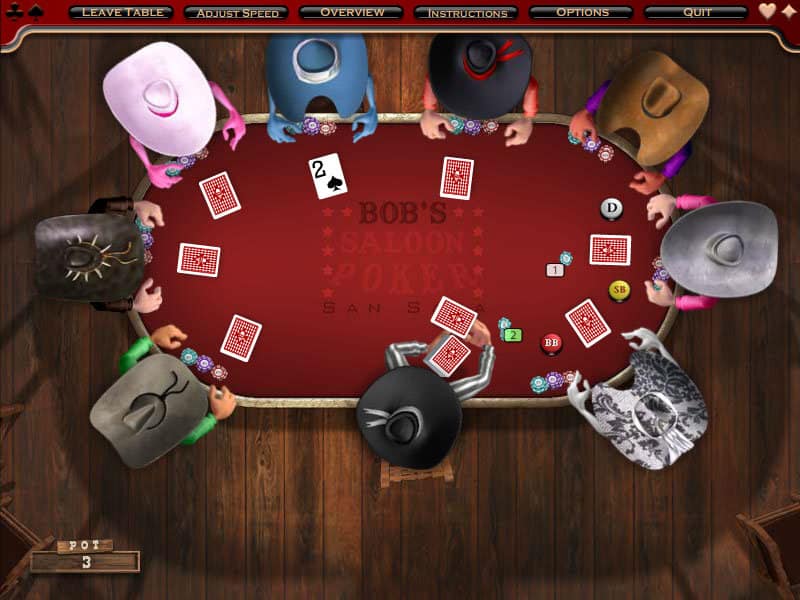
Depending on the game rules, one or more players may be required to place an initial amount of money into the pot before the cards are dealt. These are called forced bets and come in three forms: antes, blinds, and bring-ins.
Like most card games, the dealer shuffles the deck of cards. The deck is then cut, and the appropriate number of cards are dealt face-down to the players. In a casino a 'house' dealer handles the cards for each hand, but a button (any small item used as a marker, also called a buck) is rotated among the players to determine the order of dealing and betting in certain games. In a home game, the right to deal the cards typically rotates among the players clockwise, but a button may still be used.
After the initial deal, the first of what may be several betting rounds begins. Between rounds, the players' hands develop in some way, often by being dealt additional cards or replacing cards previously dealt. During a round of betting, there will always be a current bet amount, which is the total amount of money bet in this round by the player who bet last in this round. To keep better track of this, it is conventional for players to not place their bets directly into the pot (called splashing the pot), but rather place them in front of themselves toward the pot, until the betting round is over. When the round is over, the bets are then gathered into the pot.
After the first betting round is completed (every participating player having called an equal amount), there may be more rounds in which more cards are dealt in various ways, followed by further rounds of betting (into the same central pot). At any time during the first or subsequent betting rounds, if one player makes a bet and all other players fold, the deal ends immediately, the single remaining player is awarded the pot, no cards are shown, no more rounds are dealt, and the next deal begins. This is what makes it possible to bluff.
At the end of the last betting round, if more than one player remains, there is a showdown in which the players reveal their previously hidden cards and evaluate their hands. The player with the best hand according to the poker variant being played wins the pot.
Hands[change change source]
Download Governor Of Poker 1
The following are poker hands, from best to worst:
- Straight flush: Five cards of the same suit in sequence (if those five are A, K, Q, J, 10; it is a Royal Flush)
- Four of a kind: Four cards of the same rank and any one other card
- Full house: Three cards of one rank and two of another
- Flush: Five cards of the same suit
- Straight: Five cards in sequence (for example, 4, 5, 6, 7, 8)
- Three of a kind: Three cards of the same rank
- Two pair: Two cards of one rank and two cards of another
- One pair: Two cards of the same rank
- High card: If no one has a pair, the highest card wins
Poker Chips[change change source]
Poker chips are small disks. They made by various materials including molded plastic, colored metal molded clays. They are used in table games as play money. Modern poker traces its roots towards the 1800s, and in those days, players used what you could to help keep a tally. Coins, gold dust and nuggets were used until they considered replacing with something which would indicate them. Thus, the casino chips happen to be introduced within the gambling business.
Poker rooms started using casino chips to simply manage the cash and then collect charges. In those days, casino chips were created of ivory, bone, paper wood. However, the most generally used chips were created of composite clay. One problem made an appearance due to the developing casino chips which was cheating. Some players considered sneaking some chips in their hands. To avoid this, manufacturers created differentiated disks. Consequently, a range of styles was created. With time, other manufacturers could use many other materials for making casino chips, for example, plastic and metal.[2]
As Poker 1st
Poker variations[change change source]
References[change change source]
- ↑Reuben, Stewart 2001. Starting out in Poker. London: Everyman/Mind Sports. ISBN 1-85744-272-5 Basic teaching text, explains terms, gives advice.
- ↑'poker-teacher.net > Poker Chips'. poker-teacher.net. Retrieved 2018-08-10.
